
Corruption Prevention through Digitalisation
Digitalisation is widely recognised as a powerful tool in corruption prevention. Automation reduces reliance on manual processes, data analytics enhances transparency and risk detection, and embedded system controls strengthen governance and oversight. Our work in this area dates back to the 1980s.
Digitalisation Timeline
CPD provides advice for major computerisation projects across government departments, ensuring that corruption prevention controls are in place during the transition from manual systems to digital processes.
Through regular procedural reviews, CPD advises government departments to adopt digitalisation to strengthen controls in their processes.
Digitalisation for Corruption Prevention was formalised as a key strategy, recognising technology as a critical enabler of systemic integrity.

Developed the Digital Corruption Prevention Framework, providing guiding principles for government departments to leverage technology to strengthen corruption prevention.

Advanced implementation through digital tools and AI proof‑of‑concept projects.
Launched the Coding4Integrity Asian Youth Anti‑Corruption Hackathon, promoting youth empowerment, cross‑border collaboration, and innovative technology solutions for integrity challenges.

Developed the Integrity Assurance Standards for Computer System to provide practical guidance to organisations on integrating integrity controls into IT systems by design.
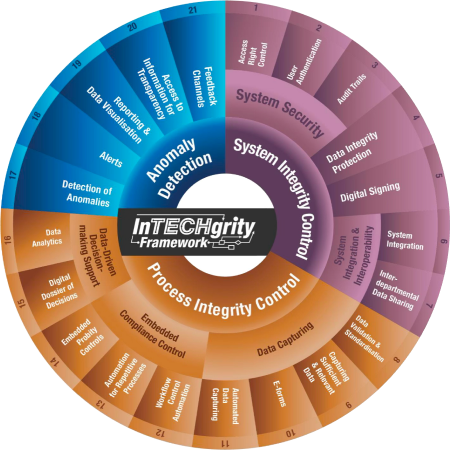
The InTECHgrity Framework sets out 21 essential integrity controls for computer systems to prevent and mitigate corruption risks. These controls are grouped under three overarching control objectives.
System Integrity Controls
Safeguarding the system's core functions
These controls protect the technical foundation of the system through secure configuration, strong access management, segregation of duties, and tamperresistant audit trails, ensuring the system cannot be easily manipulated or overridden.
Process Integrity Controls
Embedding integrity into digital workflows
These controls ensure that workflows — from data capture to approval — are systemenforced to prevent manipulation, reduce excessive discretion, and close process loopholes through automation and builtin safeguards.
Anomaly Detection Functions
Enabling early identification of irregularities
These functions leverage analytics, alerts, dashboards, and exception reporting to detect unusual patterns and red flags early, enabling timely intervention and continuous control enhancement.
Visit this website (https://www.icac.org.hk/icac/intechgrity/en/index.html) to learn more about each control, and download the guide (add link) for detailed information.
What's News
View All News